Clean Energy,
Smarter Future
At the center of a world where environment and technology coexist in harmony stands Hansung Enertech.
Contact Us
At the center of a world where environment and technology coexist in harmony stands Hansung Enertech.
Contact Us


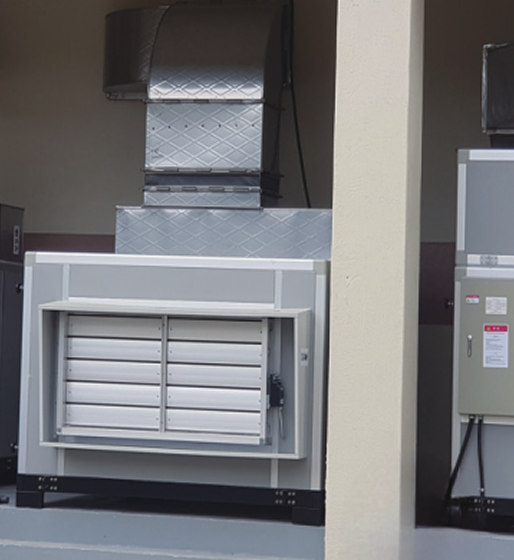
Supply air and exhaust air are handled simultaneously within a single unit, ensuring highly efficient and balanced ventilation.
The supply fan is equipped with a filtration system that removes fine dust, yellow dust, and other airborne contaminants from outdoor air before it is introduced indoors.
When integrated with a heat exchanger, thermal energy from the exhaust air is recovered and transferred to the air supply. In the winter, incoming cold air is preheated, significantly reducing thermal discomfort and stress for kitchen staff.
In facilities with access to groundwater tanks, a cooling/heating coil can be installed in the air handling unit. By utilizing the relatively stable groundwater temperature, the system provides cooling in summer and heating in winter, maintaining a comfortable kitchen environment.
Noise levels are substantially reduced. High-capacity exhaust and supply fans are inherently noisy; however, the dedicated kitchen air handling unit houses both fans internally, preventing noise from propagating outside the equipment.
Airflow rates of both the supply and exhaust fans can be precisely controlled. This allows ventilation volumes to be adjusted according to kitchen operating conditions, optimizing air balance while reducing unnecessary power consumption caused by excessive fan operation.
| No. | Ventilation Method | Issues |
|---|---|---|
| 1 | Exhaust fan–focused ventilation | Insufficient exhaust efficiency due to lack of make-up air; excessive heat buildup in the workspace |
| 2 | Insufficient exhaust airflow | Internal contamination and inhalation of harmful gases |
| 3 | No or insufficient supply fan | Inadequate make-up air; infiltration of excessively cold or hot outdoor air |
| 4 | No air supply filtration | Direct exposure to external contaminants |
| 5 | ON/OFF operation only | No airflow modulation; inability to control power consumption |
| 6 | No noise reduction | High noise levels leading to potential complaints |
| No. | Ventilation Method | Issues | Solution |
|---|---|---|---|
| 1 | Exhaust fan–focused ventilation | Insufficient exhaust efficiency; excessive heat | Integrated supply-and-exhaust air handling unit |
| 2 | Insufficient exhaust airflow | Internal contamination and harmful gas exposure | Powerful and highly effective ventilation |
| 3 | No or insufficient supply fan | Inadequate make-up air; cold/hot air intrusion | Temperature differential reduced through heat recovery |
| 4 | No air supply filtration | Exposure to external contaminants | Filtered supply air |
| 5 | ON/OFF operation | Noise complaints; no airflow control | Variable airflow control |
| 6 | No noise reduction | Noise-related issues | Noise reduction |
Based on site-specific conditions—including available installation space, installation constraints, kitchen area and required airflow capacity, as well as the application of heat exchangers and coils—appropriate unit models and airflow specifications are selected, engineered, and supplied in accordance with project drawings.
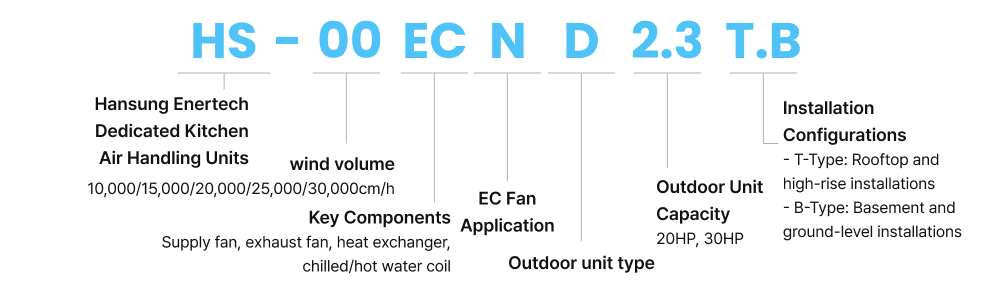
Model Classification Code Description
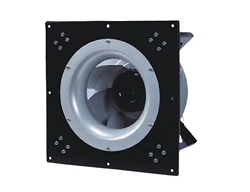
Low-noise, compact design Significantly quieter operation compared to conventional Sirocco fans Approximately 50% reduction in size versus Sirocco fans, enabling a more compact overall unit design Contributes to cost reduction through space and material efficiency
Integrated inverter control Conventional Sirocco fans do not allow RPM control EC plug fans support precise RPM modulation, enabling airflow control based on indoor conditions and reducing operating and maintenance costs
MB(Melt Blown nonwoven fabric) Designed to filter incoming outdoor air using melt-blown nonwoven media; for kitchen applications with high airflow demand, large-surface-area filters with low static pressure loss are applied Kitchen-grade filters process large volumes of air and therefore require periodic replacement to maintain filtration performance, prevent external contamination, and sustain fan efficiency
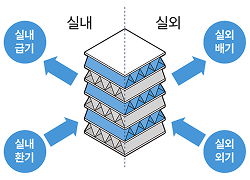
Air-to-air heat exchange type in which exhaust air and supply air cross-flow, enabling thermal energy transfer In kitchen environments, exhaust air temperature is high during winter; heat recovery preheats incoming cold outdoor air, reducing thermal discomfort for kitchen staff caused by cold drafts
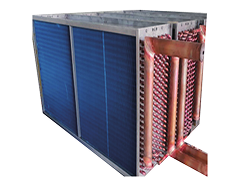
Groundwater or municipal water typically maintains a stable temperature range (15–18 °C); when water circulates through the coil and outdoor air passes across it, hot air can be cooled in summer and cold air can be warmed in winter Continuous water flow is required; particularly suitable for kitchens with high water usage or facilities equipped with underground water storage tanks, where stored water can be circulated through the coil for effective temperature control
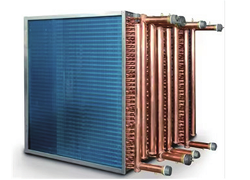
A direct expansion refrigerant heat exchanger used in HVAC systems; high-pressure liquid refrigerant expands through an expansion valve, atomizes into mist, evaporates at low pressure, and absorbs heat to cool the air As a heat exchanger, the DX coil becomes cold during refrigerant evaporation Designed to accommodate various refrigerants used in direct expansion air handling units, including R-22, R-134a, R-407C, and R-410A
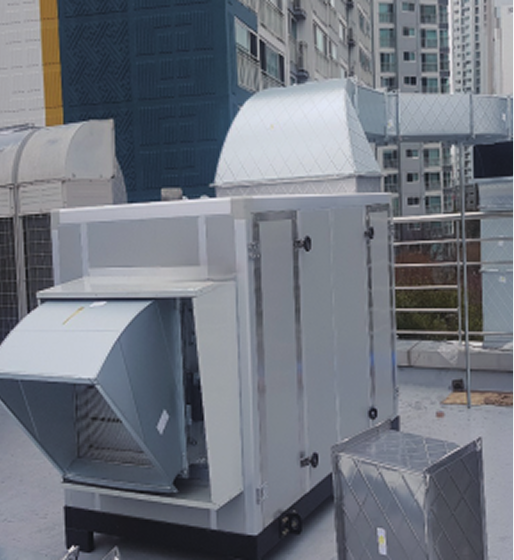
Daejeon Dongsan High School
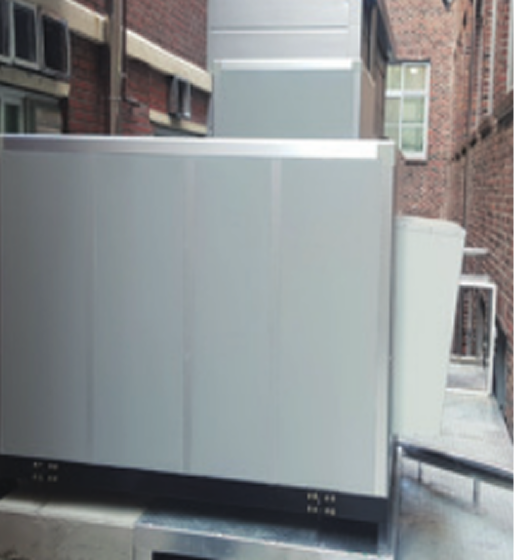
Daejeon Jungil High School

Daejeon Hosudon Girls’ High School

Copyright ⓒ 2025. All Rights Reserved.

Through the privacy policy, the company informs you of the purpose and method of use of the personal information you provide, and what measures are being taken to protect your personal information.
- Self-identification, real name verification, confirmation of subscription intent, use of age
- restricted services according to service use
- Contract performance regarding service provision and fee settlement, content provision, purchase and fee payment, product delivery or sending of invoices, etc.
- Delivery of notices, securing communication channels for complaint handling, securing accurate delivery information when delivering products
- Information for providing the latest information such as new services and providing personalized services
- Other smooth provision of high-quality services, etc.
- Name, company name, email, address, contact information, mobile phone number, inquiry content, and other optional items
- In principle, personal information is destroyed without delay upon achieving the purpose of collection or provision.
- However, in order to provide smooth service consultation, the contents may be retained for 3 months after the consultation is completed, and in cases where preservation is required by other laws such as the Act on Consumer Protection in Electronic Commerce, the information will be retained for a certain period of time.
In principle, the company destroys the relevant information without delay after the purpose of collecting and using personal information has been achieved. The information you entered for membership registration, etc. is transferred to a separate DB (separate file in the case of paper) after the purpose has been achieved, and stored for a certain period of time according to internal policies and other relevant laws and regulations for information protection reasons (see retention and use period) and then destroyed. Personal information transferred to a separate DB will not be used for any other purpose than that for which it is retained, unless required by law. Personal information stored in electronic file format is deleted using a technical method that makes it impossible to reproduce the record.


